
Google-Funded AI Wildfire Detection Cameras Launch in Oregon’s Columbia Gorge: Why Five-Minute Detection Changes Incident Command
By Robert Grand | Battalion Chief, Eugene Springfield Fire | 24 Years in the Fire Service

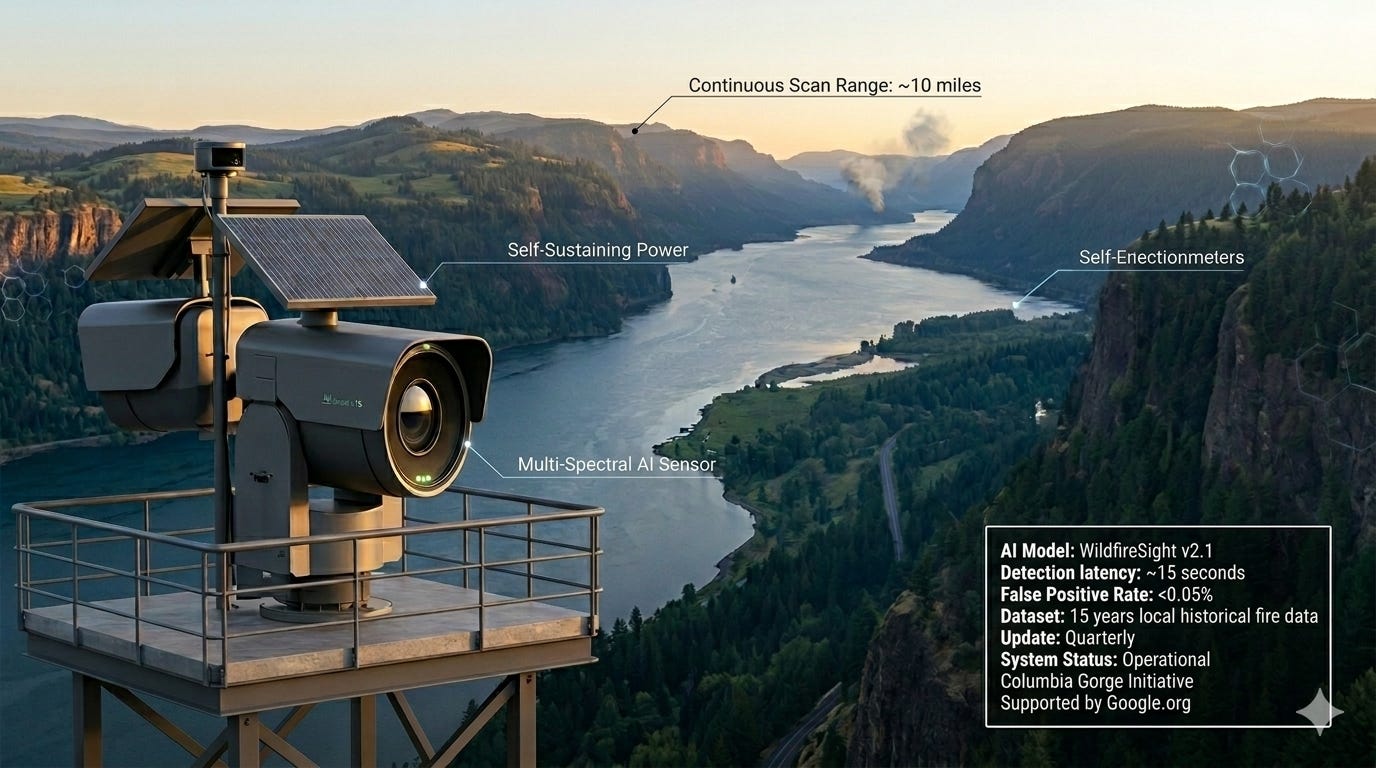
The University of Oregon Hazards Lab just announced a $250,000 Google-funded expansion of their wildfire detection network in Wasco County. New AI-integrated cameras will scan the Columbia Gorge every two minutes, flag smoke signatures, and alert fire authorities in approximately five minutes from initial detection to dispatch notification. It’s the kind of infrastructure announcement that lands in the trade press once and then gets filed away.
The detail that stops me isn’t the funding. It’s what five minutes of early detection actually enables in the field.
What the University of Oregon Just Built
The Oregon Hazards Lab installed 360-degree cameras with integrated machine learning models designed to detect fire signatures in wildland and WUI terrain. When the system flags a potential fire, two human reviewers independently verify the coordinates before the system transmits the alert to emergency responders. The cameras will integrate with ALERTWest.live, a multi-state platform that now displays feeds from 1,800 cameras across the West, operated cooperatively by the University of Oregon, University of Nevada Reno, and UC San Diego.
The Wasco County deployment is responding directly to the 2025 Rowena Fire, which burned over 3,700 acres in two weeks and destroyed dozens of structures in and around The Dalles. The region experiences roughly 30 significant fires annually. Five-minute early detection in that environment is not a feature upgrade. It’s an operational game changer.
What Five-Minute Detection Actually Feels Like in the Field
I’ve been using the ALERTWest system operationally in Eugene for the past two years. The University of Oregon provides access to agencies across the region. I configured an account, set up monitoring zones for our service area, and registered my phone for AI-flagged anomaly alerts during fire season.
Over the past two years, I’ve received multiple text alerts. Each time, I pulled up the live camera feed and assessed what the system detected. Some alerts were evolving grass fires. Some were active wildland incidents. Several were structure fires inside Eugene and Springfield, detected by tower cameras positioned around the city. In multiple instances, those alerts got me heading toward the fire in the field before dispatch had received a 911 call or had time to dispatch units.
That is the operational reality. Early detection doesn’t replace dispatch. It augments dispatch with the kind of situational awareness that lets you roll before the call comes in.
The Problem Fire Chiefs Are Still Solving in Their Own Way
Here’s what’s been invisible in every wildfire detection conversation I’ve been in: nobody talks about the five-minute window explicitly. The pitch is always about coverage. More cameras. Wider network. Better AI. Get more eyes on the forest.
All of that is true. And none of it changes the fundamental constraint: a fire that spreads at 10 acres per minute is already 50 acres into spread by the time dispatch has cleared the initial call, assigned units, and transmitted a dispatch message. Five minutes earlier detection means you’re stopping a 50-acre fire at 30 acres. You’re stopping a potential structure loss at the grass stage. That delta is everything.
Fire departments are already solving this problem themselves, in piecemeal ways. Some have assigned staff to watch camera feeds manually during season. Some have relationships with BLM or Forest Service that give them early sightings. Some rely on spotters and good luck. These workarounds cost labor, political relationships, and availability. They work until they don’t.
The infrastructure that ALERTWest represents standardizes what the best departments are already doing and makes it operational for everyone.
What “Early Detection” Actually Means When You’re Running the Call
The gap between vendor definition and operational reality is almost always in the details. Vendors talk about minutes. Operators talk about what those minutes actually change on scene.
In a five-minute window, you move from reactive response (fire reported, dispatch sends units) to predictive positioning. You have time to stage apparatus at likely access points. You have time to request mutual aid before the initial dispatch clears. You have time to notify downstream agencies. You have time to begin evacuation protocols in WUI zones before firefighters are calling for rescues.
More critically, you have time to do these things because a computer flagged smoke signatures, not because a family member called 911 from a burning house. That’s a fundamentally different starting position for incident command.
I’ve spent twenty-four years managing fire ground situations that became critical because initial response was reactive. I’ve also managed calls where early information changed the entire posture of the first five units. The difference between those two scenarios is always available time. ALERTWest gives you time.
The Network Is Growing, and So Is the Standard
The Wasco County expansion is one piece of a larger deployment. The University of Oregon is coordinating with the Bureau of Land Management, U.S. Forest Service, Oregon Department of Forestry, utilities, and local agencies. The network is growing state by state. Fire departments in the Gorge region, the Willamette Valley, and across the Pacific Northwest now have access to live feeds and AI-flagged alerts.
The practical ask is straightforward: if you’re in the coverage area, request access to ALERTWest during season planning. Set up your monitoring zones. Configure your alert notifications. Test integration with your CAD system before the fire season starts, not during a working fire.
If you’re outside the current network, track expansion timelines. In two years of operational use, I’ve learned that early detection powered by AI and distributed camera networks isn’t coming someday. It’s operational now. The departments building it into their incident command workflows are operating at a different level than the ones waiting for a perfect solution.
The fire that changes your season is the one you detect at 10 acres, not the one you respond to at 100. Technology isn’t magic. But five minutes is.
Robert Grand is a Battalion Chief at Eugene Springfield Fire with 24 years of service. He writes Frontline Intelligence, a newsletter on operational doctrine, technology, and leadership in Fire & EMS.
If this landed, share it with someone in Fire & EMS who needs to hear it.
#FireService #EMS #WildlandFirefighting #FireDispatch #PublicSafety #AI