
Tri-Cities Put AI on Their Fire Dispatch Line. The Tech Press Missed Why That Matters.
By Robert Grand | Battalion Chief, Eugene Springfield Fire | 24 Years in the Fire Service

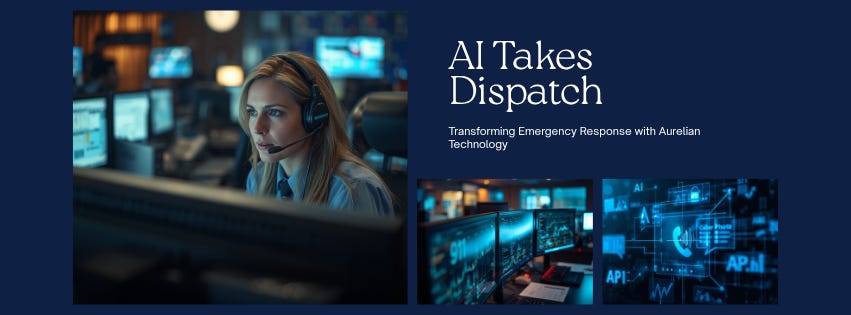
Last month, the cities of Richland, Pasco, and Kennewick put a voice AI on their non-emergency fire and police lines. A Seattle company called Aurelian provides the system. The 911 lines were not touched. Non-emergency calls hit the AI first; it triages, resolves what it can, and escalates to a live dispatcher when it detects frustration, anxiety, or specific trigger words. The agency held to a 10 to 15 second answer SLA, and they are hitting it.
The tech press covered it as a staffing story. Understaffed PSAP turns to automation. Another agency choosing AI because the bench is thin. GovTech (https://www.govtech.com/em/preparedness/tri-cities-in-wash-turn-to-ai-for-understaffed-911-dispatch) ran it that way. Industry blogs picked it up. Most chiefs in the PNW registered the headline and scrolled on.
That was the wrong read.
This is the first production-grade voice agent operating inside a fire and police service in our region. It is the first time AI is answering the call that you, your medic, or your engine company will eventually respond to. And it is happening three hours up I-84, not in some Bay Area pilot.
What Aurelian Actually Does
The system answers the non-emergency line. Address verification. Lockout. Smoke smell with no visible fire. Abandoned vehicle. Welfare check that does not sound like a crisis. The kind of calls a dispatcher used to handle by reading from a clipboard and typing into the CAD while the radio talked at them.
The agent listens, classifies the call, and either resolves it or escalates. When it escalates, the live dispatcher does not get a cold transfer. They get a structured ticket already populated. Address, callback, complaint category, caller emotional state, transcribed exchange so far. The handoff is cleaner than what most agencies achieve between two human dispatchers in the same room.
The 10 to 15 second SLA matters. That number is operational reality, not a benchmark slide. Tri-Cities is hitting it consistently in production, on real calls, in week one and presumably in week twelve.
Aurelian is not the only vendor moving this direction. Several voice-agent companies are pointed straight at public safety answering points right now. Tri-Cities happened to be the first PNW agency to go live. They will not be the last.
What the Non-Emergency Line Actually Carries
Most chiefs underestimate what runs through the non-emergency line. It is not a side channel. Non-emergency eats a real chunk of total dispatch labor, more than chiefs assume until they actually pull the numbers.
That labor was always doing two jobs at once. Routing calls and triaging emotional state. The dispatcher answering a complaint about a barking dog at 0245 is also screening for the caller who says ‘barking dog’ but means ‘I am scared and I don’t know what number to call.’
That second job is the hard one. It is the one nobody puts in the position description, and everybody quietly relies on the senior dispatcher to do well. It is also the job most at risk when AI takes the front of the line.
The Aurelian system addresses it explicitly. The escalation triggers include emotional cues. That is not a small detail. That is a vendor naming the senior dispatcher’s invisible skill out loud and trying to encode it in software. The fact that they tried matters. Whether they got it right is the question every PNW chief should be asking next.
The Decision Most Chiefs Have Not Made Yet
Here is what I have not heard a single chief in the region say out loud. Picking a non-emergency voice agent vendor is no longer a back-office IT decision.
It sets the first voice your public hears when they call fire or police but not 911. It sets your liability surface when the agent misclassifies an emergency as non-emergency. It sets your data sovereignty posture when those recordings get subpoenaed, retained, used to train the next version of the model, or pulled into an Oregon public records request you did not anticipate. It sets the bargaining position for your dispatchers, who are now downstream of a model, not just upstream of a caller.
That is not a vendor demo decision. That is a policy decision that touches operations, IT, legal, labor, and community trust. The chiefs who treat it like specifying a new piece of apparatus, multi-stakeholder, multi-quarter, with policy written before procurement, will end up with systems that work for their service.
I have lived a version of this story before, in a different software cycle. Leave the selection to IT alone, and you end up with a tool that is bulletproof from a security posture and almost unusable from the kitchen table. Locked down, audit-clean, and operationally miserable. The crew works around it. The chief signs off on it. Nobody is happy with what shipped.
AI raises the stakes on that pattern. The data flow is bigger, more sensitive, and less reversible. If the guardrails are not designed by people who understand how a fire and EMS service actually handles patient information, scene details, and confidential dispatch traffic, you will end up with a system that is technically secure and operationally leaky. No fire or EMS agency in this country can afford that kind of leak. Not legally, not politically, not with our patients.
IT belongs in the room as an advisor, not as the sole decision maker. Chiefs take the seat. Legal, labor, dispatch, and operations belong at the same table. Policy gets written before procurement, not after.
The chiefs who treat it like a CAD upgrade will discover, the way some discovered with body cams, that the technology arrived faster than the policy.
What ‘Just Non-Emergency’ Actually Means
The other gap nobody is naming. ‘Just non-emergency’ is the foot in the door.
The vendor pitch in 2026 is non-emergency only. 911 untouched, fully human, no AI between caller and life safety. That is a smart go-to-market. It lowers the political and operational risk of the first deployment. Tri-Cities almost certainly made the right call going there first.
But the trajectory is obvious. The same vendors will be back in 2027 with 911 augmentation features, pre-arrival voice agents, structured queries the dispatcher can hand off to the AI mid-call. The technology will be there. The cost pressure will be there. The political ceiling will be lower because non-emergency already proved the model can work.
If your agency has not written a position on AI in dispatch by the time those 911 features hit the market, you will not be deciding whether to adopt them. You will be reacting to whichever vendor wins the next procurement cycle. That is a worse seat to negotiate from.
The Call Is Coming
Eugene. Portland. Vancouver. Salem. Bend. Olympia. Tacoma. The Aurelian story is not a curiosity from across the Columbia. It is the first live data point in a regional shift that will close inside 24 months.
The chiefs who treat it that way will get to shape it. The chiefs who treat it as someone else’s story will get whatever the vendor sells the slowest mover in their region.
I do not know yet what the right policy looks like in our service. I know what the first three questions are. I know who needs to be in the room when we work through them. I know that ‘we will figure it out when the vendor calls’ is not the answer I want to be giving my next chief.
The technology problem was solved last year. The procurement problem is solved this year. The policy problem is the one we still own.
Robert Grand is a Battalion Chief at Eugene Springfield Fire with 24 years in the fire service. He writes the Frontline Intelligence newsletter for emergency services, by someone who still runs calls.
If this landed, share it with a chief who needs to hear it.
Reference: Tri-Cities in WA Turn to AI for Understaffed 911 Dispatch (GovTech) - https://www.govtech.com/em/preparedness/tri-cities-in-wash-turn-to-ai-for-understaffed-911-dispatch